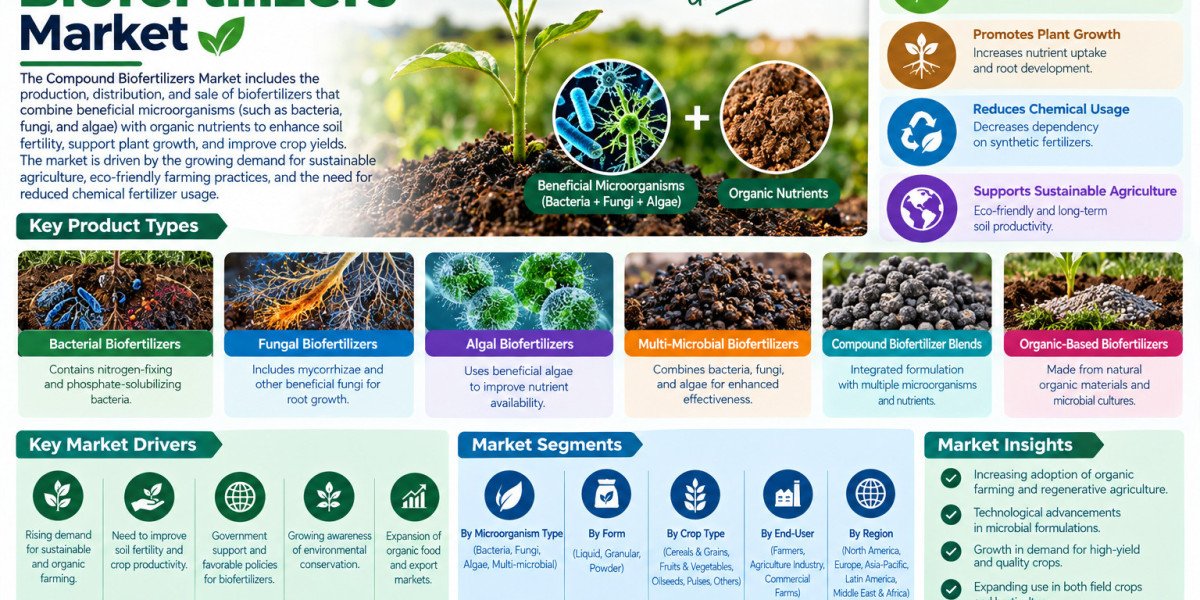

Agriculture is increasingly focused on improving soil quality, supporting plant growth, and adopting farming practices that work in harmony with natural processes. Compound biofertilizers and customized fertilizers are becoming relevant within this changing agricultural environment because they can be designed around specific crop, soil, and cultivation requirements. Instead of relying on a single type of nutrient input, modern farming approaches are increasingly considering combinations of biological and nutritional solutions. This shift is encouraging interest in fertilizer products that can support productive cultivation while fitting into broader sustainability goals.
The growing focus on sustainable soil fertility is influencing how farmers and agricultural professionals approach crop nutrition. Soil is a complex growing environment in which nutrients, microorganisms, moisture, organic matter, and plant roots interact continuously. Compound biofertilizers can complement these natural interactions by introducing beneficial biological components, while customized fertilizers can be formulated around particular cultivation needs. The combination creates opportunities for more targeted approaches to agricultural nutrient management.
One of the important factors supporting interest in compound biofertilizers is the growing awareness of soil health. Healthy soil provides an important foundation for crop development, and maintaining its biological activity is an ongoing agricultural priority. Biofertilizer-based solutions can be incorporated into farming systems where microorganisms have an important role in nutrient availability and soil interactions. This makes biological fertilizer products attractive to growers who want to explore approaches that extend beyond conventional nutrient application.
Customized fertilizers also have an important role in modern agricultural practices. Different crops have different nutritional requirements, and soil conditions can vary considerably between cultivation areas. A standardized fertilizer approach may not always address the specific needs of every crop or growing environment. Customized products provide an opportunity to consider crop characteristics, soil conditions, cultivation practices, and nutrient requirements while developing a more targeted fertilizer strategy.
Another factor shaping the market is the increasing interest in sustainable agricultural inputs. Farmers, agricultural businesses, and technology providers are exploring ways to improve resource management while maintaining crop productivity. Compound biofertilizers can form part of these strategies by combining biological components with nutrient-supporting functions. Customized fertilizer products can also support more deliberate application practices by aligning formulations with particular agricultural requirements.
Innovation is expected to remain an important feature of this market. Manufacturers are exploring improved formulations, combinations of beneficial microorganisms, and fertilizer compositions designed for different crops and soil environments. Research and development activities can help improve product consistency, storage characteristics, application convenience, and compatibility with modern farming practices. These developments can make biological and customized fertilizer products more accessible across different agricultural applications.
The market also benefits from growing interest in precision-oriented agriculture. Modern farming increasingly uses information about soil characteristics, crop conditions, and cultivation practices to make more informed decisions. Customized fertilizer solutions fit naturally into this approach because formulation and application can be connected with specific agricultural conditions. This can encourage fertilizer manufacturers to develop increasingly specialized product portfolios.
Distribution and farmer awareness will also influence market development. Agricultural inputs need to be accessible, understandable, and practical for growers. Manufacturers and agricultural organizations can support adoption by explaining application methods, compatibility, storage requirements, and expected agricultural functions. Education can be especially important for biofertilizers because their biological nature may require different handling and application considerations than conventional fertilizer products.
Overall, compound biofertilizers and customized fertilizers represent an evolving area of agricultural input innovation. Their relevance is connected with soil health, crop-specific nutrition, sustainable cultivation, and the broader movement toward more targeted farming practices. As agriculture continues to explore resource-conscious solutions, the market can remain closely connected with developments in biological inputs, customized crop nutrition, and modern agricultural management.
FAQs
Q1. What are compound biofertilizers?
Compound biofertilizers are agricultural inputs that combine biological components with other fertilizer functions to support crop nutrition and soil-related processes.
Q2. Why are customized fertilizers important?
Customized fertilizers can be developed around particular crop and soil requirements, allowing agricultural users to pursue more targeted nutrient management.